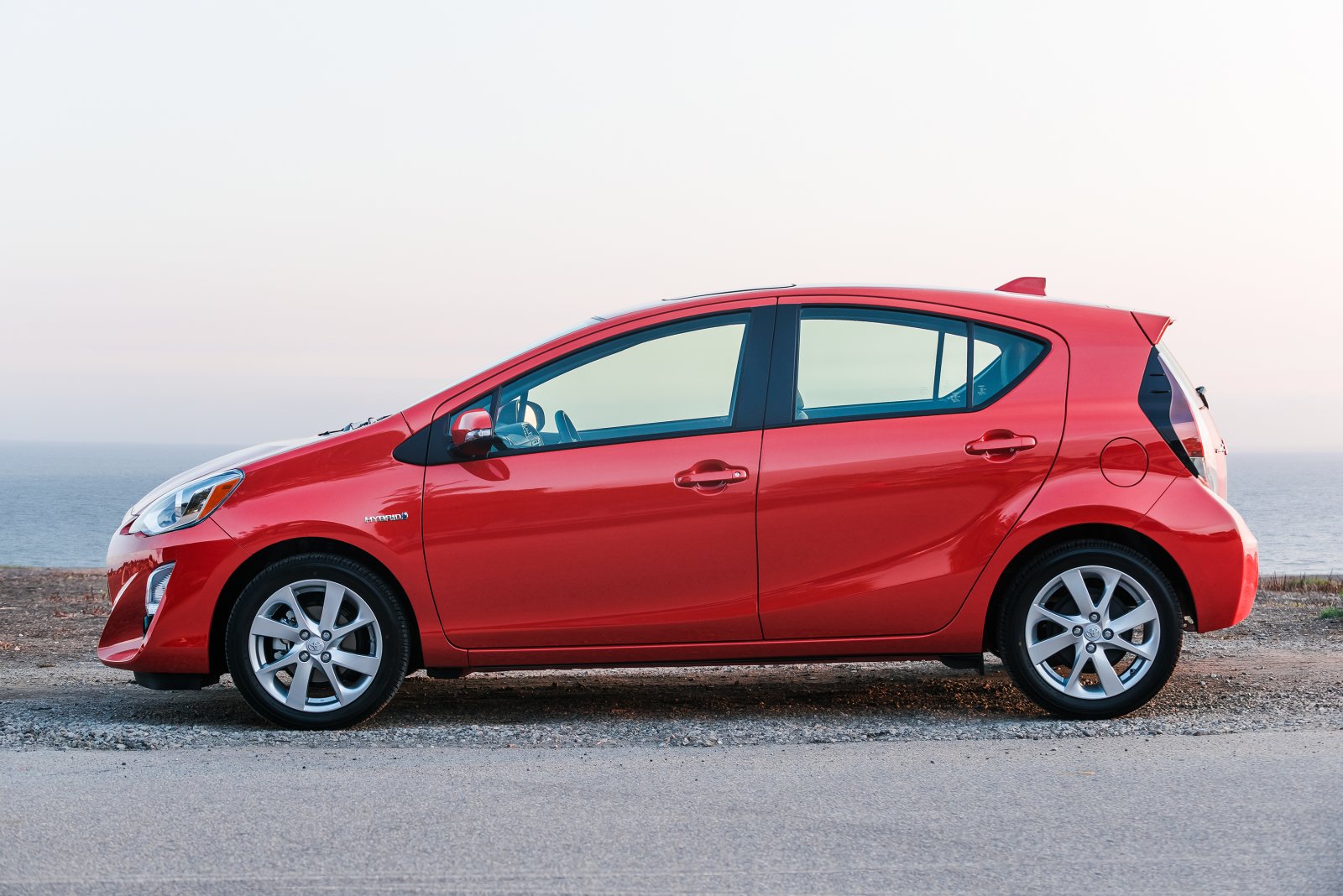
One of the most affordable hybrid vehicles on the market just added another compelling reason to buy for 2017. The Toyota Prius
c,
the smallest of the brand’s eight hybrid models, now comes standard
with the Toyota Safety Sense C (TSS-C) driver-assist technologies on all
model grades. The TSS-C system, which had been an option on two Prius
c grades for 2016, includes Pre-Collision System, Lane Departure Assist, and Automatic High Beams.
That’s big news, of course. But then, the compact Prius
c has
been a newsmaker since it joined the Toyota line. A redesigned front
fascia, rear bumper, side rocker panels and blacked-out rear spoiler
give the 2017 Prius
c a big infusion of sporty attitude. All grades now also roll on standard alloy wheels.
A Big Safety Announcement from Toyota
Toyota Safety Sense-C is designed to help address three key areas of
driver assistance: preventing or mitigating frontal collisions, helping
maintain driving within their lane, and enhancing road safety during
nighttime driving. Toyota plans to make automatic emergency braking
standard on nearly all models by the end of 2017. That will put Toyota
(and Lexus) four years ahead of the model-year 2022 industry target
announced by the National Highway Traffic Safety Administration (NHTSA)
and Insurance Institute for Highway Safety (IIHS).
Urban? Suburban? Yes.
One doesn’t need to live in a congested urban area to get why the “c” in Prius
c
stands for “city.” Yet, even out in the ‘burbs, one can appreciate the
vehicle’s 158.7-inch length, which makes it a shoe-in for those “compact
only” parking spaces located so conveniently near mall entrances.
Thanks to clever design, the Prius
c makes great use of the
space at hand. The 35-inch rear legroom and 17.1 cu. ft. cargo volume
(with rear seatbacks up) let you take friends to the mall in comfort,
and carry home everyone’s packages with ease. The bottom line is that
the Prius
c provides a lot of cabin space while taking up little road space.
Smart packaging also makes the Prius
c highly maneuverable,
thanks to optimal location of the compact gasoline engine, transaxle and
power-control unit. Locating the hybrid battery and fuel tank beneath
the rear seat puts their mass within the car’s wheelbase, a boon to
weight distribution and handling agility. The body structure’s high
torsional rigidity allows the suspension to be more optimally tuned for a
smoother ride and more agile handling. The Prius
c rides on
standard 15-inch alloy wheels on all grades. A 16-inch aluminum alloy
wheel option with P195/50R16 tires is available for the Prius
c Four.
In the city, suburbs or wide-open spaces, the standard single LED
projector low- and high-beam headlights and LED tail and brake lights
give you a bright road ahead. Exterior color choices like Absolutely
Red, Blue Streak Metallic and Tangerine Splash Pearl may not be ideal
for those in the Witness Protection Program.
Prius c Hybrid Technology
Toyota optimized the size and weight of its hybrid technology for the Prius
c
platform, but that doesn’t mean it left anything out. The system
integrates a gasoline engine, an electric motor within a Continuously
Variable Transaxle, a nickel-metal hydride battery, a power control unit
(inverter), a DC-DC converter and a step-up converter. A hybrid control
computer governs the seamless application of gasoline engine and
electric power depending on driving demands and selected drive mode.
The Prius
c’s SULEV (Tier 2 Bin 3)-rated 1.5-liter inline
four-cylinder gasoline engine utilizes an Atkinson cycle to help
increase efficiency. By itself, the engine produces 73 horsepower and 82
lb.-ft. of torque, contributing to a total hybrid system output of 99
hp. The hybrid system also yields excellent fuel efficiency with an EPA
estimated MPG of 48 city/43 highway/46 combined.
Like today’s luxury and sport models, the Prius
c offers
different drive modes to affect performance response. Normal mode works
for everyday driving. ECO reduces overall energy consumption by
governing the climate control system and throttle operation to help
enhance vehicle efficiency. Under certain conditions EV Mode allows the
Prius
c to be driven solely by electric power for under one
mile while remaining below 25 mph. That’s useful when navigating one of
those huge mall parking lots, for example.
Compact on Size, Big on Safety
The addition of the Toyota Safety Sense C system to all 2017 Prius
c
models is designed to help drivers avoid hazards on the road. But
Toyota also built the Prius c to help protect passengers. Extensive use
of lightweight, high-strength steel contributes to the vehicle’s ability
to absorb and disperse impact energy, helping to enhance occupant
safety.
The body covering that structure slips through the air with a low 0.28
coefficient of drag, the result of extensive aerodynamic features. The
Prius
c’s lower-body styling is wider below the beltline, featuring sculpted rear flares that express an athletic stance.
The 2017 Prius
c is equipped with nine airbags and, features
the standard Star Safety System™, which includes Vehicle Stability
Control (VSC), Traction Control (TRAC), Anti-lock Brake System (ABS),
Electronic Brake Force Distribution (EBD), Brake Assist (BA), and Smart
Stop technology.
Toyota Safety Sense-C (TSS-C) featuring Automatic Emergency Braking
The Toyota Safety Sense-C system standard in the 2017 Prius
c combines a trio of driver assist technologies anchored by automatic emergency braking.
Pre-collision System (PCS), which operates at vehicle speeds of
approximately seven to 85 mph, is designed to use a camera and laser
beam to detect the vehicle ahead. If PCS determines there is a
possibility of a collision, it uses audio and visual alerts to prompt
the driver to take evasive action and brake. If the driver notices the
hazard and applies the brakes, PCS may provide additional braking force
using Brake Assist. If the driver does not brake in a set time, and PCS
determines that the possibility of a frontal collision with another
vehicle is extremely high, the system may automatically apply the
brakes, helping reduce speed by approximately 19 mph in order to help
the driver lessen the impact and in certain cases avoid a collision. The
operational range of automatic braking covers speeds at which at least
80 percent of rear-end collisions occur (approximately seven – 50 mph).
Lane Departure Alert (LDA) is designed to use a camera to detect
visible white and yellow lane markings in front of the vehicle and the
vehicle’s position on the road. If LDA determines that the vehicle is
starting to unintentionally deviate from its lane, the system alerts the
driver with an audio and visual alert.
Automatic High Beam (AHB), using an in-vehicle camera to help
detect the headlights of oncoming vehicles and taillights of vehicles
traveling ahead, automatically switches between high and low beams as
appropriate.
Toyota Value in Four Grades
The Prius
c cabin looks as sporty as the exterior and of course
delivers familiar Toyota value. The four model grades make it easy to
choose the ideal Prius
c for any budget or taste.
The Prius
c One comes well equipped with standard color-keyed
power outside mirrors with turn signal indicators; tilt/telescopic
steering wheel with steering wheel controls; air conditioning; remote
keyless entry system with illuminated entry; power windows and more. The
standard 3.5-in. TFT Multi-Information Display provides the driver with
outside temperature display, clock, fuel economy information, cruising
range, odometer, trip distance, EV miles driven, Hybrid System
Indicator, ECO Savings, ECO Score and energy monitor.
The Prius
c One comes ready to play music any way the driver wants. The standard Entune
® Audio system includes the Entune
®
Multimedia Bundle with a 6.1-in. touch-screen display; AM/FM CD player
(with MP3/WMA playback capability); four speakers; auxiliary audio jack;
USB 2.0 port with iPod
® connectivity and control; advanced voice recognition and Bluetooth
® for hands-free phone capability, phone book access and music streaming. Apple iPhone
® users can speak requests using Siri
® Eyes Free.
Stepping up to the Prius
c Two brings two-tone fabric-trimmed
seats; six-way adjustable driver’s seat; 60/40 split fold-down rear
seats; cruise control, a cargo area cover and engine immobilizer. The
cabin shows a premium touch with piano black, chrome and soft-touch
upgraded accents, shared with the Three and Four grades, as well.
Technology comes to the fore in the Prius
c Three, which adds
the Smart Key System on the front doors and liftgate; Push Button Start
and remote illuminated entry; Touch Tracer Display and Entune
®
Premium Audio with Integrated Navigation and App Suite. This
comprehensive multimedia system includes everything from the standard
setup and adds two more speakers (six total, plus the Entune
®
App Suite; HD radio; HD predictive traffic and Doppler weather overlay;
AM/FM cache radio; SiriusXM All Access Radio with three-month
complimentary trial and Gracenote
® album cover art.
For a taste of luxury, the Prius
c Four adds LED fog lights on
the outside and, on the inside, a power tilt/slide moonroof with sliding
sunshade; integrated backup camera; SofTex
®-trimmed seats, plus heated steering wheel, front seats, and outside mirrors.
With all that great tech and high fuel economy in the Prius
c,
it seems only logical that Best Buy’s Geek Squad will dispatch more than
1,000 of the vehicles – fully decked out as the new Geekmobile –
nationwide. Prius
c offers enough cargo space to shuttle just
about anything a Geek Squad agent might need, whether optimizing a home
theater system or improving Wi-Fi performance or installing a security
solution.