
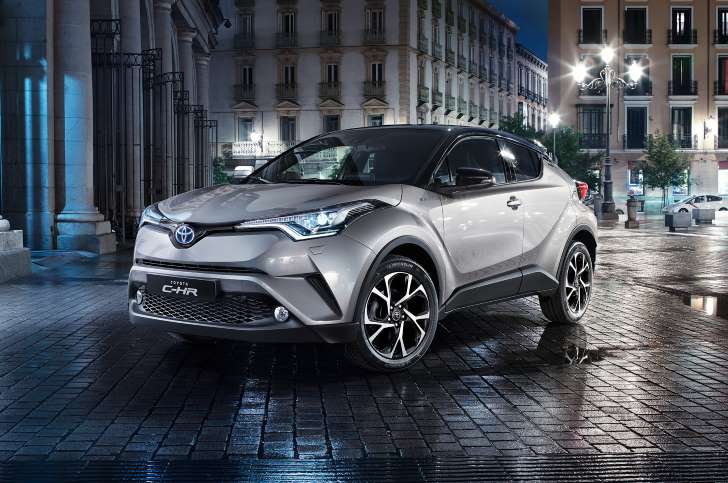
Toyota Motor Corp. says its new C-HR compact crossover is the car for people who dislike Toyotas. If early sales data are any indication, there are a lot of Toyota critics out there.
The C-HR is almost single-handedly driving sales growth in Europe and Toyota’s home market of Japan. Between those two markets, Toyota sold about 150,000 of the vehicles in the first half of 2017—more than a 10th of its total sales there, out of dozens of models. Without that, overall sales volume would have declined in both markets.
Sales of the C-HR in the U.S., where it starts at $22,500, have been slower, partly because of supply constraints and demand for larger vehicles. Still, in every market the car is achieving its main mission of winning converts, said the Toyota engineer who led the C-HR’s development.
“I think we’ve been able to attract new customers who in the past wouldn’t have even looked at Toyota cars, because this car is so un-Toyota,” said engineer Hiroyuki Koba.
Toyota’s focus has long been on building cars that some could describe as boring, Mr. Koba said. “For models that sell well, our cars tend to be acceptable to everyone—cars that won’t cause anyone to complain.”
The C-HR is trying to change that perception, as part of Toyota Chief Executive Akio Toyoda’s plan to breathe more life into its designs.
When the company gave a preview last year, Mr. Koba said it was designed for “customers who dislike Toyota cars.” With sharp edges and a face evoking a scowling Kabuki actor, the car marked a departure for a company that plodded its way to selling 10 million vehicles a year.
Toyota called the design sensual and said it resembled a “sexy diamond.” Some Wall Street Journal readers who commented after the first look were less kind, with one comparing it to a “squashed frog.”
Whatever it is, it isn’t boring.
“There are not many people who will hang up their BMW keys for a Toyota, but we’ve been seeing that with the C-HR,” said Thomas Obee, whose family-owned Motorline Group in the U.K. opened its first Toyota dealership in 1976 and now has 13 in the country.
In Japan, the C-HR has been near the top of the charts since it went on sale at the end of last year and even hit the No. 1 spot in April, a rare feat in a market dominated by the hybrid Toyota Prius and other small, fuel-efficient cars.
Toyota desperately needed a crossover in the popular entry-level category, which has gained popularity globally including developing markets like China and India. Crossovers are built on the architecture of sedans and hatchbacks, but their bodies resemble sport-utility vehicles, which means they have more room for bodies and cargo, but are more fuel-efficient than full-size SUVs built on truck frames.
“What’s the growth segment of the future? I think it’s going to be entry-level crossovers” like Honda’s HR-V and Toyota’s CH-R, said Bob Carter, Toyota’s U.S. sales chief. “That segment didn’t exist a couple of years ago, but I don’t think it’s a stretch that in three, four or five years out it’ll be a million” sales annually, he said.
In the U.S. the C-HR’s price puts it in reach of first-time car buyers. But so far, only a few thousand C-HRs are selling each month in the U.S., a fraction of Toyota’s larger and more expensive RAV4 and Highlander models.
Toyota says that is partly because it can’t build enough C-HRs to meet demand. It is building a new factory in the U.S. to catch up.
Almost all the C-HRs sold in Europe and the U.S. come from Toyota’s plant in Turkey, which is running the assembly line around the clock, six days a week to try to keep pace with demand. Toyota says it is looking at ways to boost production.
It could also be that the un-Toyota-like styling is putting off American buyers. “It’s a weird car, and it’s small,” said Felipe Munoz, an auto analyst at Jato Dynamics, a U.K.-based automotive research firm. “It can really work as it does in Europe and Japan, or it couldn’t—as it is in the U.S.”
Brandon Stanhope, general manager at Sheehy Toyota in Stafford, Va., says that when C-HRs arrived on his lot, “It took a cup of coffee on the first day to get used to.”
Sheehy Toyota has sold 13 C-HRs since April, which Mr. Stanhope says he views as a moderate success. “What did it for me was to drive it, to feel the sportiness,” Mr. Stanhope said.
Sheehy Toyota ordered more C-HRs for the showroom after seeing many customers comparing the C-HR with Subaru Corp.’s Crosstrek, one of the most popular small crossover models in the U.S. Subaru sold over 50,000 Crosstreks in the first seven months of the year.
The C-HR is one of three models, alongside the Prius Prime plug-in hybrid and the new Camry, featuring edgier designs advocated by Mr. Toyoda, the CEO.
The Prius Prime got a wider, more aggressive face and a curvy “double-bubble” rear windshield, design details that make the car look “like the future,” the company says. But sales have been tepid, even in Japan where other versions of the Prius have been No. 1 sellers for years. Just a few thousand Prius Primes are selling per month in each of the major markets.
The bigger test is the new Camry, which was once Toyota’s best-selling vehicle in the U.S. but has experienced a recent sales slide. Mr. Toyoda touted the vehicle’s design in January, saying it was available in two flavors, “sexy” and “really sexy.” It went on sale in Japan and the U.S. in late July to mostly positive reviews, although J.D. Power called the sportier styling “a tad bit silly.”